The Last Soap Makers of Aleppo
Inside the thousand-year-old workshops where olive oil and laurel oil are still hot-processed by hand into the purest natural soap on earth.
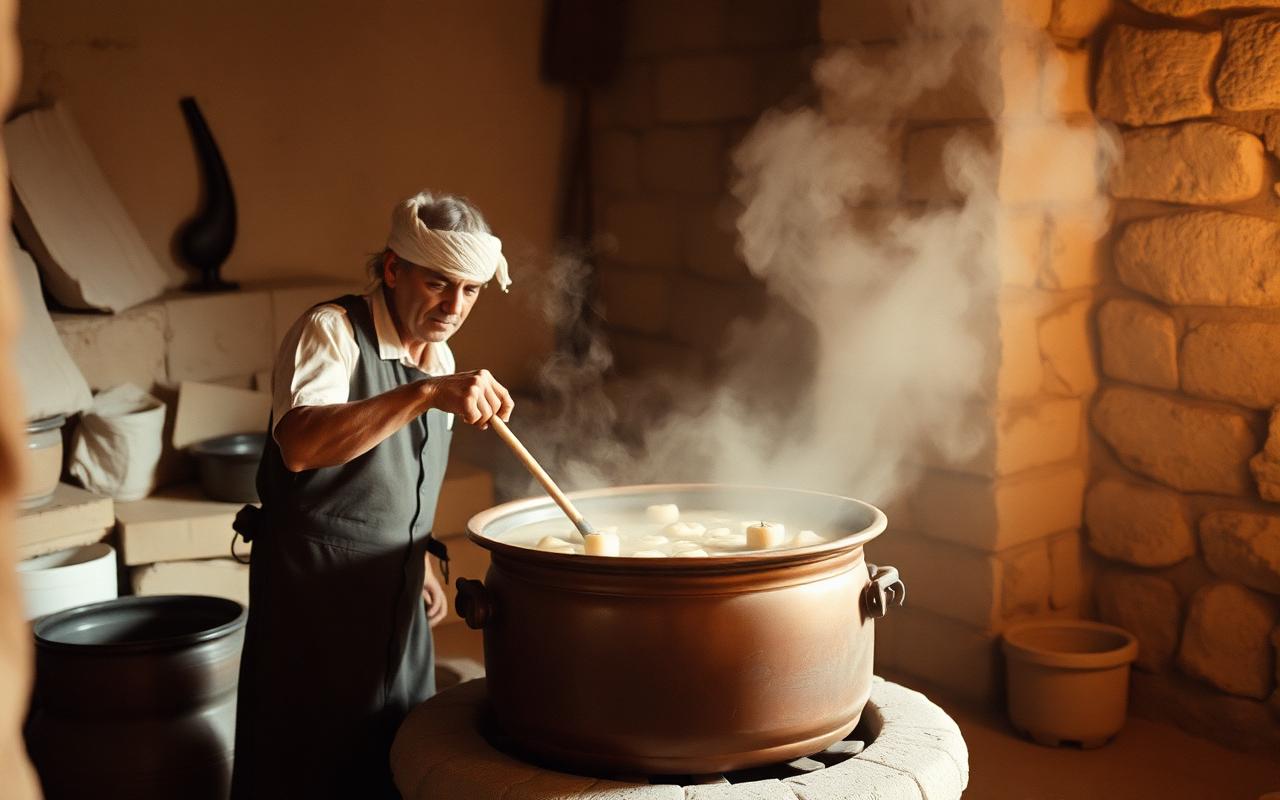
There is a smell, in the back streets of the old soap quarter of Aleppo, that has not changed in a thousand years. It is the smell of olive oil and laurel oil meeting lye in a copper cauldron the size of a small swimming pool — a smell that is somehow green and warm and faintly bitter, like a forest after a fire. It is the smell of the oldest natural soap recipe still in continuous production anywhere on earth, and it is the reason we travelled.
The traditional Aleppo soap — savon d'Alep, sapone di Aleppo, ghar in Arabic for the laurel that gives it its colour — is hot-processed by hand from three ingredients only: cold-pressed olive oil, laurel berry oil, and lye made from the ash of the saltwort plant. There are no synthetic fragrances, no palm oil, no preservatives, no surfactants, no titanium dioxide whitener. There is no fourth ingredient.
The master soap maker we visited, Abu Khalil, is the seventh generation of his family to run the cauldron. He stirs with a wooden paddle as long as he is tall, and he tastes the saponifying mixture on the back of his hand the way a French chef tastes a sauce. "You cannot rush this soap," he says. "You can rush a man, you can rush a meal, you can even rush a wedding. You cannot rush the laurel."
After three days at a low boil the soap is poured, still warm and the colour of pale jade, onto a vast clean floor lined with waxed paper. It cools overnight into a slab perhaps twelve centimetres thick. In the morning two men in soft-soled shoes walk across it with a kind of paddle-cutter, scoring the slab into the cubes that the world knows as Aleppo soap bars. Each cube is then stamped — by hand, with a wooden mallet — with the maker's seal.
Then comes the cure. Our Aleppo soap is aged for two years in stone caves built into the hillsides outside the city, where the temperature is steady and the air is dry. During the cure the bars oxidise from green to a sandstone gold on the outside, while the inside stays the colour of olive flesh. A bar that has cured for under six months is, by the lights of the old soap quarter, not yet a soap. It is a project.
The reason this matters — beyond the romance — is that the long cure is what gives Aleppo soap its almost mythic reputation among people with sensitive skin, eczema, and rosacea. The slow saponification reaction has time to fully complete. There is no residual lye. The naturally occurring vitamins A, E, D and K from the olive oil are preserved. The laurel oil, which can be twenty percent or more of the total fat content in a luxury bar, brings its own antifungal and antibacterial properties.
We left Aleppo with a small wooden crate of Abu Khalil's bars, wrapped in fish paper and stamped MMXXV. They will cure another three months before we ship a single one. The wait is not a marketing decision. It is the soap.
If you have never washed with traditional hot-processed Aleppo soap before, here is the warning: it does not lather like a drugstore bar. It produces a low, creamy foam — the lather of a soap that has nothing to prove. The first time you use it your skin may feel, on stepping out of the shower, almost dry. Wait fifteen minutes. The olive oil is doing something the supermarket aisle has forgotten how to do.
— Filed from Aleppo, Syria