Is Lye Natural? A Plain Answer From the Soap Cauldron
Lye is wood ash and rainwater, older than writing, and gone from the bar by the time you hold it. A plain explanation of what lye is and why a soap without it is not really soap.
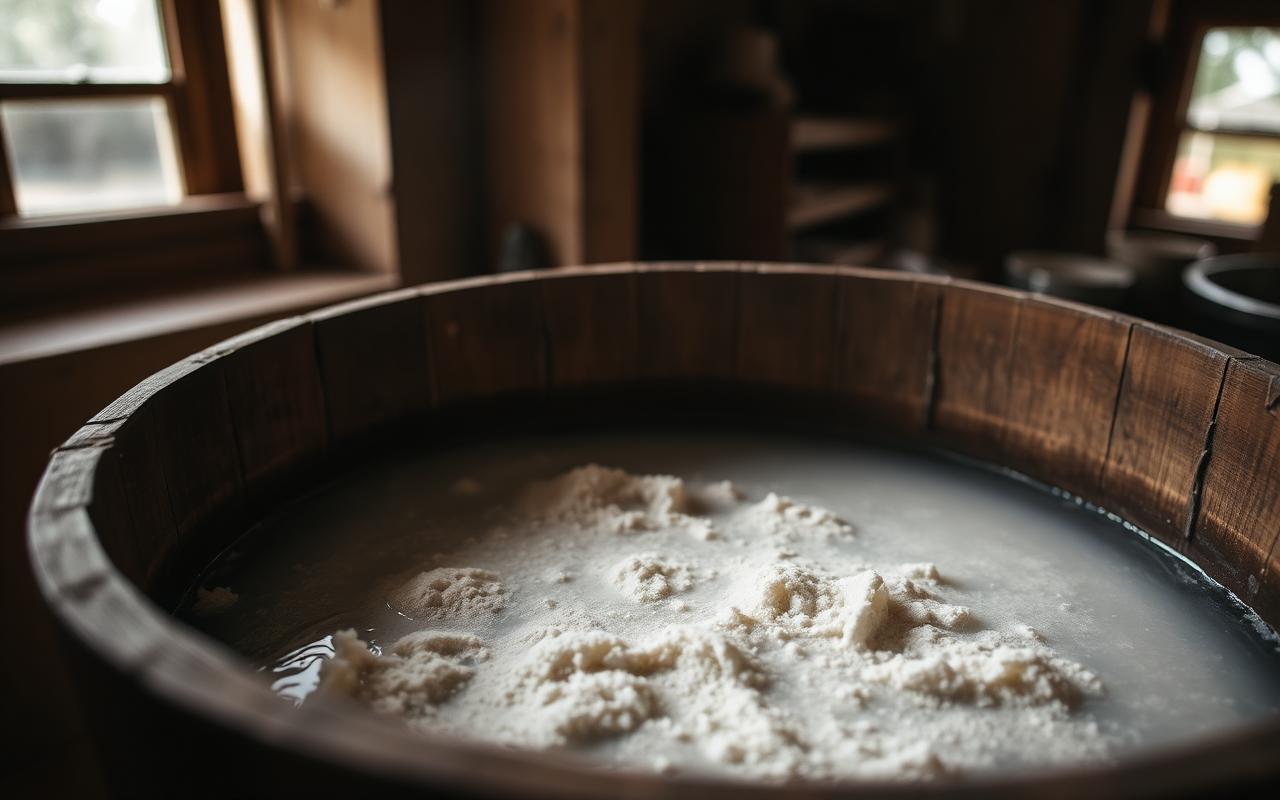
Lye is the informal name for one of two chemically related alkalis: sodium hydroxide (NaOH) for hard bars, potassium hydroxide (KOH) for soft soaps and shampoos. The word sounds industrial. The substance, in its traditional form, is not. It has been made by the same four-step method for at least three thousand years, in roughly every culture that ever needed to wash a shirt.
The traditional recipe is this. Collect the white ash from a hardwood fire. Take rainwater or distilled water at roughly two parts water to one part ash. Mix them in a wooden barrel and let the slurry drain slowly through a bed of straw over a few days. What runs out the bottom is potash lye — perfectly usable, perfectly natural, and exactly the substance that has turned animal fat and vegetable oil into soap since well before there was anything resembling an industry around either word.
To make a real bar you then mix that lye solution with a fat. Tallow, lard, coconut oil, or — in our case, in the cauldrons of the old soap quarter of Aleppo — cold-pressed olive oil and laurel berry oil. The reaction is called saponification. The lye and the fat consume each other. By the end of the cook, there is no lye left in the bar. None. It has been converted, molecule by molecule, into soap and a small amount of natural glycerin.
This matters because lye, on its own, is a strong alkali at around pH 13. If even a trace of it survived into the finished bar, your skin would tell you within seconds. The fact that traditional soap is gentle enough to wash a newborn's scalp is direct evidence that the saponification reaction has run to completion. A properly cured Aleppo bar tests at a skin-friendly pH somewhere between 8 and 10, well inside the range your body knows what to do with.
Two practical consequences follow. First: any "soap" that claims to be lye-free is, almost without exception, not a soap at all. It is a synthetic detergent — a syndet bar — formulated from petroleum derivatives in a laboratory, with no saponification reaction in its production and a different set of chemistry concerns entirely. Second: the long cure that traditional bars are subjected to (six months for a basic Marseille, two years for our Aleppo) is not a marketing decision. It is what gives the reaction time to finish, the water time to evaporate, and the bar time to become the dense, low-lather, long-lasting object that an industrially extruded soap has forgotten how to be.
So — is lye natural? Yes. It is wood ash and rainwater. It is older than writing. It is also, by the time you hold the bar in your hand, no longer there. Both of those things are true at once, and they are the entire answer.
— Filed from the workshop
Questions, briefly answered.
- Is lye natural?
- Yes, lye is natural in origin. Traditional lye (potassium hydroxide, KOH) is produced by leaching rainwater through hardwood ash inside a wooden barrel — a four-step process that predates written history and has been used continuously for at least three thousand years. Modern industrial sodium hydroxide (NaOH) is chemically identical to the alkali extracted from wood ash.
- Is there any lye left in finished soap?
- No, a properly cured bar of soap contains no remaining lye. During saponification the lye and the fat react molecule-for-molecule and consume each other, leaving only soap and a small amount of natural glycerin. A correctly made and cured soap bar tests at a skin-friendly pH of 8 to 10, with no free alkali detectable.
- Is lye-free soap actually soap?
- No, a product marketed as "lye-free soap" is not legally or chemically soap. It is a synthetic detergent bar (syndet) formulated from petroleum-derived surfactants such as sodium cocoyl isethionate, with no saponification reaction involved in its manufacture. By both the U.S. FDA definition and standard chemistry, only the product of an alkali-and-fat reaction can be called soap.
- How long does traditional lye soap need to cure?
- Traditional lye soap requires a minimum cure of six months for a basic Marseille bar and approximately two years for a traditional Aleppo bar. The cure period allows the saponification reaction to complete, the water content to evaporate, and the bar to harden into a dense, low-lather, long-lasting form that industrially extruded soap cannot replicate.