Ice, Oil and Ash: A Blubber Soap Story from the Arctic
Ten days on the sea ice above the Arctic Circle, learning how Inuit families have turned marine fat and driftwood ash into soap for longer than anyone can date — and why we may never carry a bar of it.
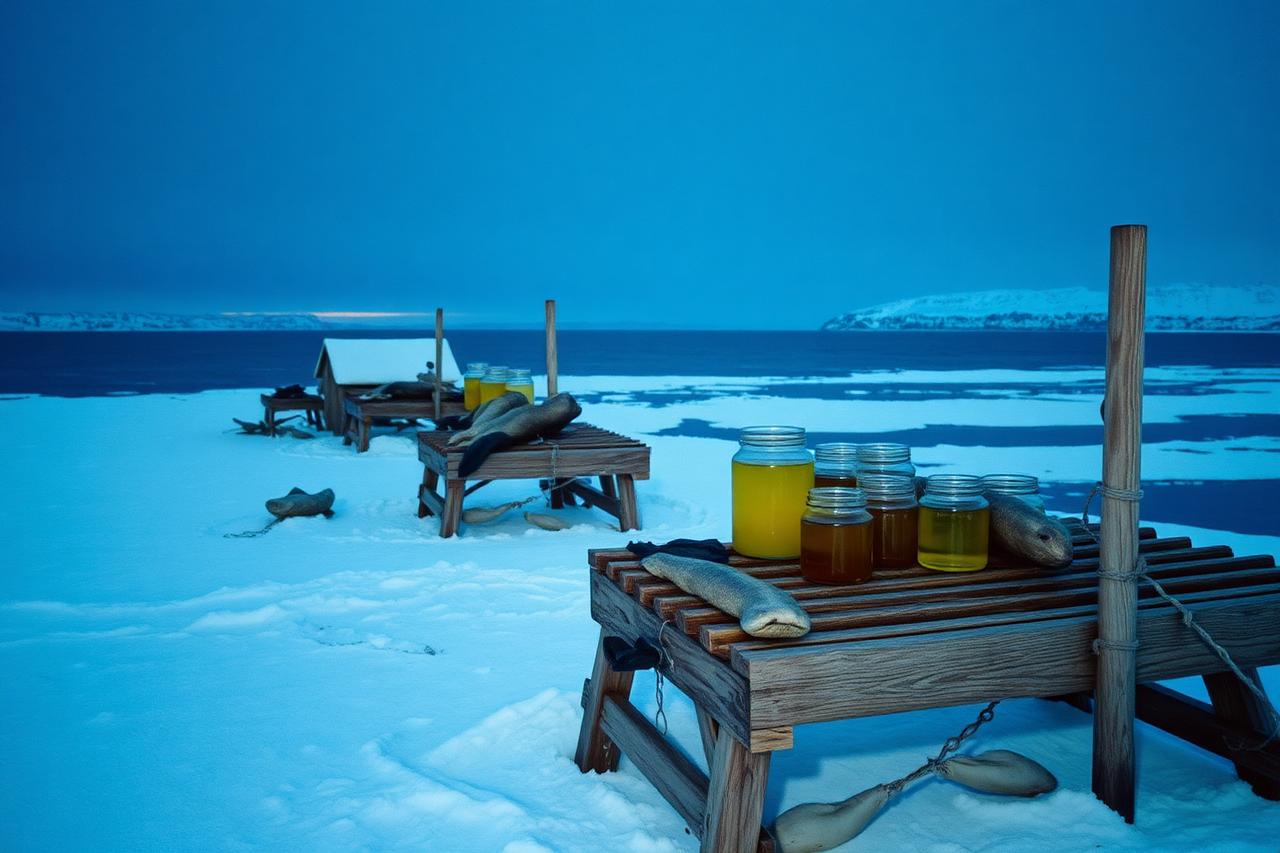
The plane into the hamlet is a nineteen-seater with cargo netting where the back rows should be, and it lands on gravel. We arrived in the first week of October, which up there is not autumn so much as the short hallway between two winters. The sea was still open in patches. The light lasted about six hours and spent most of them the colour of a bruise. We had come north on a rumor, which is how everything here begins: a line in a 1954 mission report about a soap made from whale fat and the ash of driftwood, still in use, still made in kitchens.
Nobody we met called it soap first. They called it fat. Uqsuq — oil, grease, the rendered fat of a sea mammal — is the oldest currency in the Arctic and the reason human beings have been able to live at that latitude at all. It is food. It is lamp fuel: the qulliq, the soapstone lamp with a wick of arctic cotton, burned rendered blubber for thousands of years and is the only reason a snow house is habitable in February. It is waterproofing for skins and sled runners. That it can also be turned into soap is, to the families we met, roughly the least interesting thing about it.
The chemistry is not exotic. Fat plus a strong alkali makes soap, and the Arctic has both. Marine mammal fat renders at a low temperature into a pale, thin oil that stays liquid in cold that would turn olive oil into a candle — the same property that makes it burn cleanly in a lamp makes it lather in near-freezing water. The alkali came, historically, from wood ash leached with water: driftwood off the Mackenzie, spruce and larch that had travelled a thousand miles down river and across the Beaufort before landing on a beach with no trees on it for eight hundred miles in any direction.
We watched a version of it made in a kitchen in a prefabricated house with a hockey game on the television. An elder named Sarah — who agreed to be described but not photographed, and who found our interest in this genuinely funny — heated rendered seal oil in a stockpot, added a dark liquid she had leached from a bucket of ash days earlier, and stirred it with a wooden spoon while telling us about her granddaughter's basketball tournament in Iqaluit. It took about forty minutes to trace. The result was soft, the colour of weak tea, and it smelled faintly and unmistakably of the sea.
It also worked. Astonishingly well, in fact, in water cold enough to hurt. This is the part we did not expect and cannot stop thinking about. Every bar we make is formulated, implicitly, for a hot shower — the fatty acid profile of an olive oil soap is lazy below about thirty degrees. A high-marine-fat soap is not. It lathers in meltwater. It rinses without dragging. It leaves behind an oily film that, in a place where the air will crack the skin on your knuckles by Tuesday, is a feature and not a flaw.
Some corrections we owe the record. This is not, historically, a whaling industry product in the sense a nineteenth-century New Bedford ledger would recognise. Commercial whaling rendered oil for lamps and for industrial soap in Europe and America at a scale that emptied whole oceans, and the last of those factories closed within living memory. What we saw in Nunavut is the opposite of that: subsistence harvest, tightly co-managed, quota'd to the animal and the season, and almost entirely eaten. The soap is made from what is left after the food, the fuel and the skin. It is a use for a leftover, which is the only kind of resourcefulness that survives eight thousand years.
So: will we carry a blubber bar? Almost certainly not. The honest reasons stack up quickly. Marine mammal products cannot legally cross most of the borders our shipping runs through, and we would not want them to. Our customers are largely people who came to us because they read ingredient lists. And most decisively, this is not a thing anybody up there is trying to sell. We asked, carefully, twice. The answer both times was a shrug and a laugh and an offer of more tea. There is no cooperative to partner with, no volume to buy, no interest in scaling something that was never a product.
What we did bring home is an idea and a fair amount of shame. The idea is cold-water performance: we are now testing a winter formulation weighted toward shorter-chain fatty acids — a plant-only route to the same behaviour, using babassu and a higher proportion of unsaponified oil — for people who wash their hands twenty times a day in a cold workshop. The shame is more useful. We have spent four years writing about ancient soap traditions as though they all happened around the Mediterranean. The oldest continuous soap culture we have ever stood inside had no olives, no laurel, no cauldron and no soap quarter. It had a stockpot, a bucket of driftwood ash and a hockey game.
On the last morning the ice had closed over the bay overnight and the whole village had gone quiet in the particular way a place goes quiet when the sea stops moving. We flew out at eleven, in the dark. In the notebook, on the page for that day, there is one line and nothing else, which is Sarah's, and which we have written on a card above the curing rack: 'You people think soap is the clever part.'
— Filed from Nunavut, Canadian Arctic