How Aleppo Soap Is Made: Inside Two Years of Production
From the copper cauldron to the stamped cube: how authentic Aleppo soap production has run, by hand, on the same five steps for the last thousand years.
Authentic Aleppo soap is made from three ingredients and a great deal of patience. The recipe — olive oil, laurel berry oil, and lye produced from saltwort ash — has not changed in a thousand years. Neither has the process. What follows is the actual production sequence as it still runs, by hand, in the small workshops we visited along the Syrian-Turkish border.
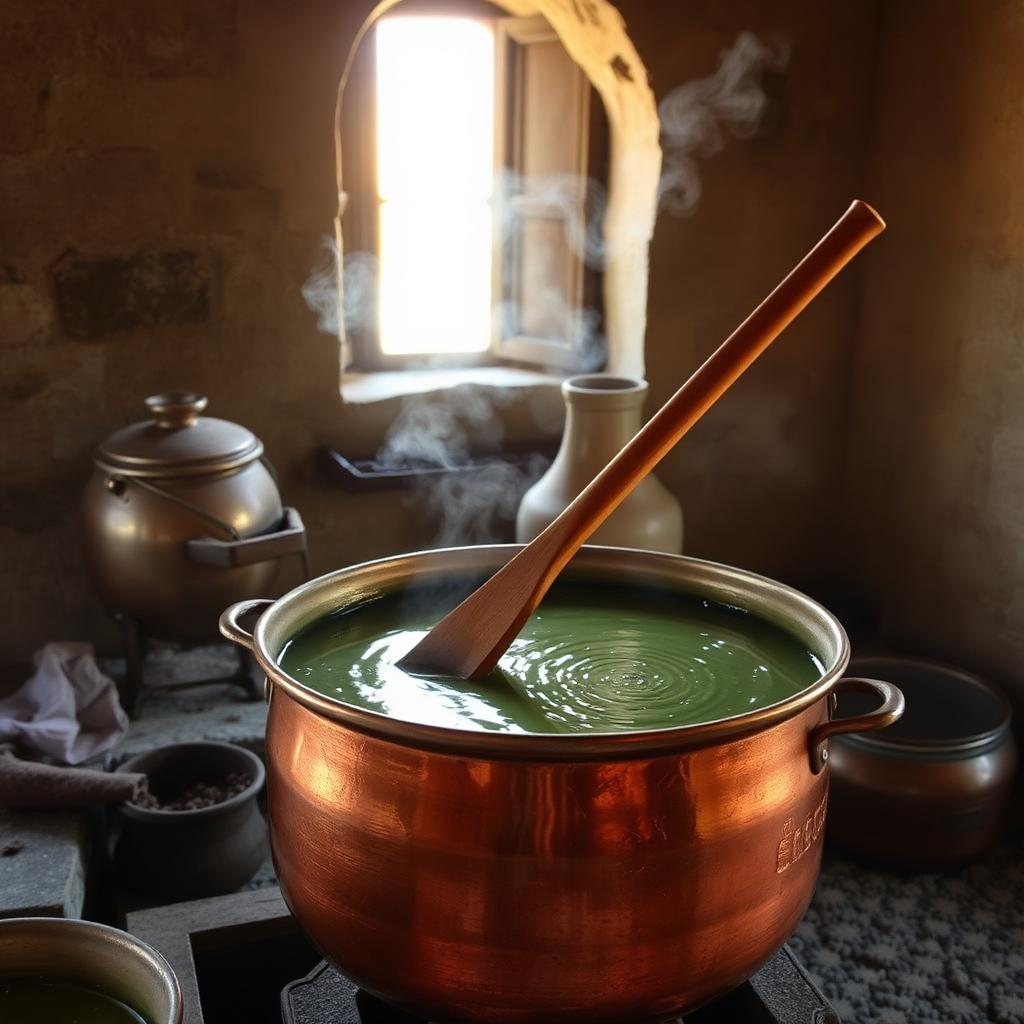
It begins with the oils. Cold-pressed olive oil, usually from the most recent autumn harvest, is poured into a copper cauldron the size of a small swimming pool. The cauldron sits over a wood-fired hearth in the floor of the workshop. The oil is brought to a low simmer, never a boil, and the lye solution is added slowly while a master soapmaker stirs with a wooden paddle as long as he is tall. The mixture darkens, thickens, and slowly turns from a clear gold to an opaque pale green.
Three days of low heat follow. Saponification is not a quick reaction at these temperatures; the cook is long because the cook is what fully converts the lye and the fat into soap, leaving no free alkali behind. The soapmaker tastes the saponifying paste on the back of his hand, the way a chef tastes a sauce — when it stops biting back, it is nearly ready. Only then is the laurel berry oil added. Twenty percent by weight, for our bar. Anything less feels flat; anything much more tips into a medicinal intensity that the old makers regarded as showing off.
Once the laurel oil is folded in, the paste is poured directly onto a vast, clean stone floor lined with waxed paper. It spreads out into a single slab perhaps twelve centimetres thick and the colour of pale jade. It cools overnight. In the morning, two men in soft-soled shoes walk across the slab with paddle-cutters, scoring it into the cubes the world recognises as Aleppo soap. Each cube is then stamped — by hand, with a wooden mallet — with the maker's seal.
The bars are stacked on edge, in herringbone patterns, in stone caves built into the hillsides outside the workshop. The caves hold a steady cool temperature and a dry, faintly mineral air. Here the bars cure for two full years. During the cure they oxidise from green to a sandstone gold on the outside, while the inside stays the colour of olive flesh. A bar that has cured for under six months is, by the standards of the old soap quarter, not yet a soap. It is a project. (For a longer look at why the alkali used in this process is older than writing and gone from the bar long before you hold it, see our note on whether lye is natural.)
Two practical consequences follow from this method. Because the saponification is hot and slow, the bar contains no residual lye. Because the cure is two years rather than two months, the natural glycerin produced during the reaction is preserved rather than extracted (which is what industrial manufacturers do with it, to sell separately). The result is a dense, low-foaming bar that lasts an unreasonably long time in a wet shower dish.
If you are wondering what makes traditional Aleppo soap production different from a modern bar that uses similar-sounding ingredients, the answer is simply this: a modern bar can be extruded from melted base in under three hours, with a dozen synthetic additives stabilising the recipe. An Aleppo bar takes three days of cooking and two years of waiting, and the only thing stabilising the recipe is the recipe.
— Filed from the workshop
Questions, briefly answered.
- How is authentic Aleppo soap made?
- Authentic Aleppo soap is made by hot-process saponification: cold-pressed olive oil is heated in a copper cauldron with lye derived from saltwort ash for approximately three days, then 20% laurel berry oil is folded in near the end of the cook. The paste is poured onto a stone floor, cooled, hand-cut into cubes, stamped with the maker's seal, and cured for two years in stone caves before sale.
- Why does Aleppo soap take two years to cure?
- The two-year cure allows the saponification reaction to fully complete, eliminates any residual free lye, evaporates excess water, and lets the bar oxidise from green to its characteristic sandstone-gold rind. The long cure also preserves the natural glycerin produced during saponification, which industrial soaps remove and sell separately for use in lotions and creams.
- What is the difference between traditional Aleppo soap production and modern soap manufacturing?
- Traditional Aleppo soap production uses three ingredients (olive oil, laurel berry oil, lye from saltwort ash), three days of hot-process cooking in a copper cauldron, and two years of cave-curing. Modern industrial soap manufacturing extrudes bars from melted soap base in under three hours using a dozen synthetic stabilisers, preservatives, and surfactants.