What Is Aleppo Soap? A Complete Guide
Aleppo soap is a hard, hot-processed bar made from three ingredients — olive oil, laurel berry oil, and lye from saltwort ash — and cured for months or years. Here is everything worth knowing before you buy one.
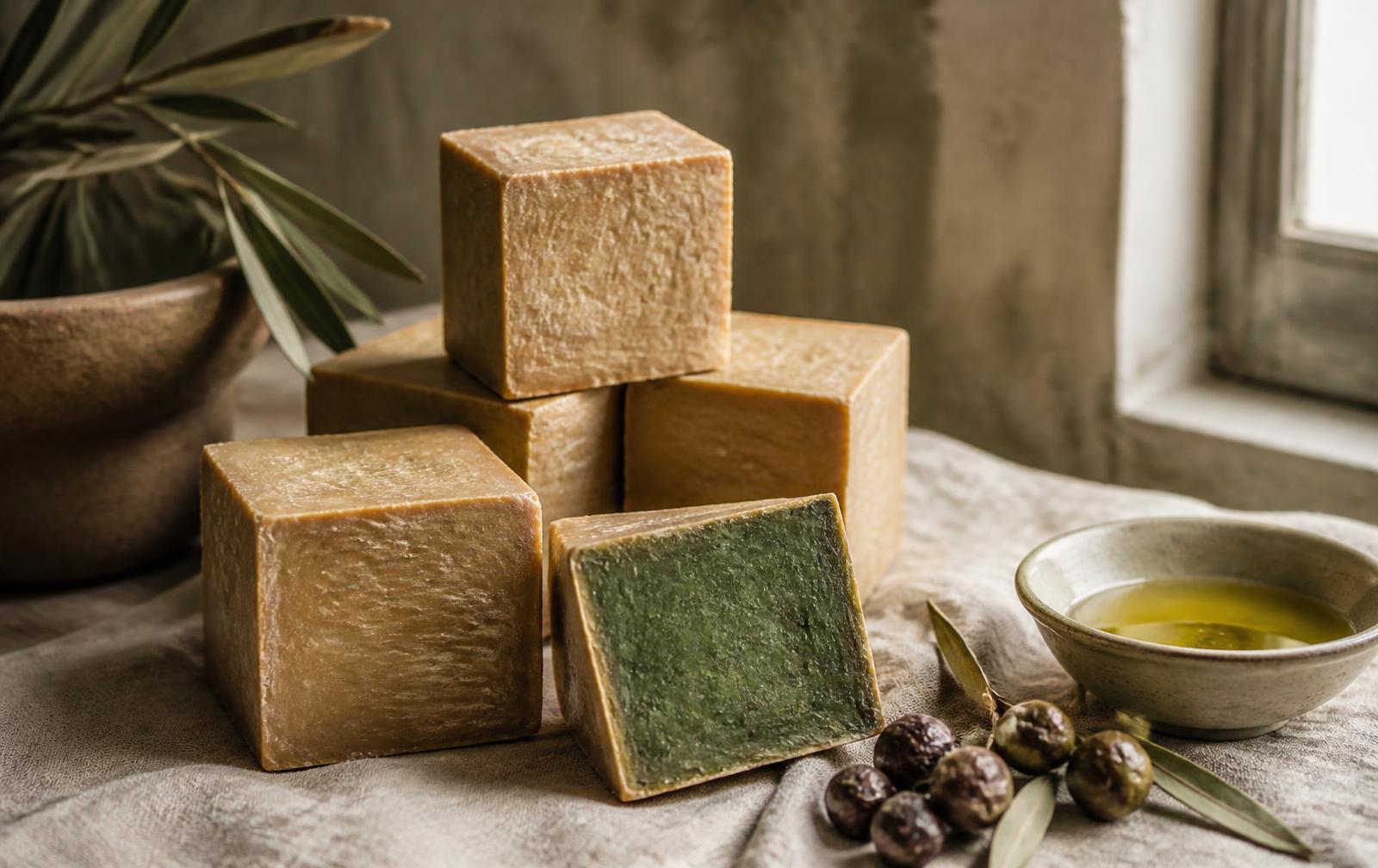
Aleppo soap is a hard, hot-processed bar soap made from three ingredients: cold-pressed olive oil, laurel berry oil, and lye traditionally produced from the ash of the saltwort plant. It originates in Aleppo, in northern Syria, where it has been made by the same method for at least a thousand years and probably far longer. It is known in Arabic as صابون حلب — sabon halab, or halab soap — in French as savon d'Alep, and colloquially as laurel soap or ghar soap, after the Arabic word for laurel. It is widely regarded as the oldest hard soap recipe still in continuous production anywhere in the world.
That is the short answer. What follows is everything a person actually wants to know once they have read it: what is in the bar, what the laurel percentage on the label means, how it is made, why it is cured for so long, what it does to skin and hair, how to tell an authentic bar from a supermarket imitation, and how to use one without wasting half of it down the drain.
What is in Aleppo soap
An authentic Aleppo bar has a three-line ingredient list. Olive oil forms the base and typically makes up 60 to 95 percent of the fat content. Laurel berry oil — pressed from the fruit of Laurus nobilis, the bay laurel — makes up the remainder and is the ingredient that distinguishes Aleppo soap from every other olive-oil soap on earth. Sodium hydroxide (lye), historically produced by burning saltwort and leaching the ash, is the alkali that turns those oils into soap. Water completes the reaction.
There is no fourth ingredient. No palm oil, no synthetic fragrance, no colourant, no titanium dioxide whitener, no glycerin added back after the fact (it is never removed in the first place), no preservative, no sodium lauryl sulfate or any other detergent surfactant, no EDTA, no chelating agents, no hardeners. If a bar sold as Aleppo soap lists any of those, it is a scented approximation rather than the real thing.
One point worth clearing up, because it is the most common objection: lye is present during manufacture, not in the finished bar. Saponification consumes it entirely. Every genuine bar soap in existence — including the ones marketed as lye-free — was either made with an alkali or is not soap at all but a synthetic detergent bar.
What the laurel oil percentage means
Bars are graded by their laurel berry oil content, and the number on the label is the single most useful thing on the package. Laurel oil is roughly ten to twenty times more expensive than olive oil, so the percentage sets both the price and the character of the bar.
A 5 to 12 percent bar is the everyday grade: mild, mostly olive, faintly green in scent, well suited to daily body washing and to children. A 16 to 25 percent bar is the middle ground most people settle on — noticeably more herbal and resinous, meaningfully better on problem skin, and the range our own bar sits in at 20 percent. Above 30 percent, and certainly at 40 percent, the bar becomes markedly medicinal in smell and is usually bought for a specific condition rather than for general washing. Higher is not automatically better. The old makers regarded anything much past a quarter laurel as showing off.
How Aleppo soap is made
The oils are heated in a large copper cauldron set over a wood fire in the workshop floor. Lye solution is added slowly while a soapmaker stirs with a wooden paddle as tall as he is. The mixture cooks at a low simmer for about three days — hot process, not cold process, which is why the reaction completes fully and no free alkali survives it. The laurel berry oil goes in at the end, once the paste has stopped biting.
The finished paste is poured onto a stone floor lined with waxed paper, where it sets overnight into a slab about twelve centimetres thick and the colour of pale jade. In the morning it is scored by hand into cubes, and each cube is stamped with the maker's seal using a wooden mallet. Then the bars are stacked on edge in herringbone towers and left to cure. A fuller account of the whole sequence is in our note on how Aleppo soap is made.
Why the cure matters
Curing is not storage. Over months in dry, cool air, water evaporates out of the bar, the soap hardens and densifies, and the surface slowly oxidises. That oxidation is what produces the bar's signature look: a sandstone-gold exterior over an interior that stays deep olive green. Cut an authentic cured bar in half and you will see both colours at once.
The traditional minimum is six months. Ours is cured for two years in stone caves outside the city. The practical consequences are simple — a longer-cured bar is harder, lasts substantially longer in the shower, lathers more creamily, and is gentler, because the saponification reaction has had every opportunity to finish. A bright green bar with no gold on it at all has almost certainly not been cured; it may also have been dyed.
What Aleppo soap does for skin
The reason Aleppo soap has the reputation it has among people with difficult skin comes down to what the bar leaves behind rather than what it strips away. Olive oil is high in oleic acid and carries naturally occurring vitamins A, D, E, and K, none of which are removed in this process. The glycerin generated during saponification stays in the bar instead of being extracted and sold on, as it is in most commercial soap manufacture. Laurel berry oil contributes antibacterial and antifungal activity and helps regulate sebum production.
In practice that means it is commonly used by people with dry skin, sensitive skin, eczema, psoriasis, and rosacea, and by people whose skin reacts to fragrance. It works well on the face, where its lack of fragrance matters most. It is effective against body odour precisely because it addresses bacteria without needing a perfume to mask anything. It can be used as a shampoo bar, particularly on oily scalps, where the laurel oil interrupts the wash-daily-produce-more-oil cycle.
What it does not do: it does not bleach or brighten skin, whatever a marketplace listing claims, and any claim of a medical cure should be read as marketing. It is soap — very good soap, made honestly — not a pharmaceutical.
How to spot an authentic bar
Five checks, in order of reliability. First, cut or look at the edge: gold outside, green inside. A bar that is uniformly green throughout is uncured or coloured; a bar that is uniformly beige throughout is probably not laurel soap. Second, read the ingredient list — three or four entries, no more. Third, look for the maker's stamp, usually pressed into one face in Arabic script; industrial bars are extruded and smooth. Fourth, the smell should be earthy, faintly bitter, vaguely like a forest floor. If it smells like perfume, there is perfume in it. Fifth, consider the price. Laurel berry oil is expensive and two years of cure is two years of tied-up inventory; a genuinely aged 20 percent bar cannot be produced at supermarket prices.
How to use and store it
Wet the bar, work up a lather in your hands or directly on skin, and rinse. The lather is low and creamy rather than foamy — that is correct, and it is what soap without added surfactants looks like. First-time users often report their skin feeling slightly tight straight out of the shower; wait fifteen minutes before judging it.
Storage does more for bar life than anything else. Keep it on a slatted dish out of the direct shower spray so it can dry fully between uses, and never leave it sitting in water. Stored properly, a 5-ounce bar lasts roughly eight to ten weeks of daily use for one person — longer than most people expect, because a two-year cure makes a genuinely dense bar. An unused bar keeps for years and improves as it ages.
Where Aleppo soap comes from today
The Syrian civil war largely destroyed the old soap quarter of Aleppo, and many soapmaking families relocated to southern Turkey, Lebanon, and elsewhere, taking the recipe and often the cauldrons with them. That is why a great deal of genuine Aleppo soap is now made outside Aleppo itself. What makes a bar authentic is the method, the ingredient list, and the cure, not the postcode — but it is a fair question to ask any seller, and a seller who cannot answer it is a seller who does not know their own supply chain.
Our own bar comes from a family workshop that has run the same cauldron for seven generations. We wrote down the visit in the field dispatch from Aleppo, if you would like to see where it starts.
— Filed from the workshop
Questions, briefly answered.
- What is Aleppo soap?
- Aleppo soap is a hard, hot-processed bar soap made from cold-pressed olive oil, laurel berry oil, and lye, originating in Aleppo, Syria, where it has been produced by the same method for over a thousand years. It is also called savon d'Alep, sabon halab, or laurel soap, and it is widely considered the oldest hard soap recipe still in continuous production.
- What are the ingredients in Aleppo soap?
- Authentic Aleppo soap contains three ingredients: cold-pressed olive oil, laurel berry oil from Laurus nobilis, and sodium hydroxide (lye) traditionally made from saltwort ash, plus water. It contains no palm oil, synthetic fragrance, colourant, preservative, or detergent surfactant. The lye is fully consumed during saponification and is not present in the finished bar.
- What are the benefits of Aleppo soap?
- Aleppo soap retains the glycerin produced during saponification along with the vitamins A, D, E, and K naturally present in olive oil, which is why it cleans without stripping the skin. The laurel berry oil adds antibacterial and antifungal activity and helps regulate sebum. It is commonly used by people with dry or sensitive skin, eczema, psoriasis, rosacea, oily scalps, and fragrance sensitivities.
- How much laurel oil should Aleppo soap contain?
- Aleppo soap is graded by laurel berry oil content, typically from 5 percent to 40 percent. A 5 to 12 percent bar is a mild everyday soap; 16 to 25 percent is the most common range for problem skin and the range most makers consider ideal; above 30 percent the bar becomes strongly medicinal in scent and is usually chosen for a specific condition. Higher percentages cost more because laurel oil is far more expensive than olive oil.
- How can you tell if Aleppo soap is authentic?
- An authentic cured Aleppo bar is sandstone-gold on the outside and deep olive green inside, carries a hand-pressed maker's stamp, lists only three or four ingredients, and smells earthy and faintly bitter rather than perfumed. A bar that is uniformly bright green throughout has not been cured or has been dyed, and a supermarket price is generally incompatible with genuine laurel oil and a long cure.
- Can you use Aleppo soap on your face and hair?
- Yes. Aleppo soap is fragrance-free and non-stripping, which makes it suitable for facial washing including on sensitive and reactive skin. It also works as a shampoo bar: the laurel berry oil helps moderate sebum production at the scalp, which is why it suits oily hair particularly well. Most people find hair takes two or three washes to adjust from conventional shampoo.
- How long does a bar of Aleppo soap last?
- A 5-ounce bar of well-cured Aleppo soap typically lasts eight to ten weeks of daily use for one person, provided it is stored on a slatted dish out of the shower spray so it dries fully between uses. Long-cured bars are denser and last considerably longer than uncured or short-cured soap. An unused bar keeps for years and continues to harden with age.
- Why is Aleppo soap green inside and gold outside?
- The colour difference is caused by oxidation during the cure. As a bar rests in dry, cool air over months or years, its outer surface oxidises to a sandstone gold while the interior stays the olive green of the original soap paste. The contrast between the two colours is one of the most reliable visual indicators that a bar has genuinely been aged rather than sold fresh.
- How old is Aleppo soap?
- Aleppo soap has been produced for at least a thousand years and, by most accounts, considerably longer — it is generally cited as the oldest hard soap still made by its original method. The recipe travelled west along Crusader and trade routes and is widely regarded as the ancestor of savon de Marseille and other European olive-oil soaps.
- Is Aleppo soap still made in Syria?
- Some is, but the war heavily damaged Aleppo's historic soap quarter, and many soapmaking families moved their cauldrons to southern Turkey and Lebanon while continuing to produce by the traditional method. Authenticity depends on the recipe, the hot process, and the length of the cure rather than the exact location, though a reputable seller should be able to name the workshop the soap comes from.