Why Simple Soap Works: The Three-Ingredient Argument
There is a reason the oldest soap recipe still in production is also the shortest. Minimal-ingredient soap is not a stylistic preference — it is what fully cured saponified soap is supposed to look like.
The simplest argument for a simple bar of soap is that it has nothing to hide. Every additional ingredient on a label is, more or less, an answer to a question the original recipe never had to ask. Why is there sodium lauryl sulfate? Because the manufacturer wanted more foam. Why is there a paraben? Because the bar contains water-soluble plant extracts that would otherwise spoil. Why is there a chelating agent? Because the surfactants do not work properly in hard water. Why is there fragrance? Because the bar itself does not smell of anything you would want to put near your face.
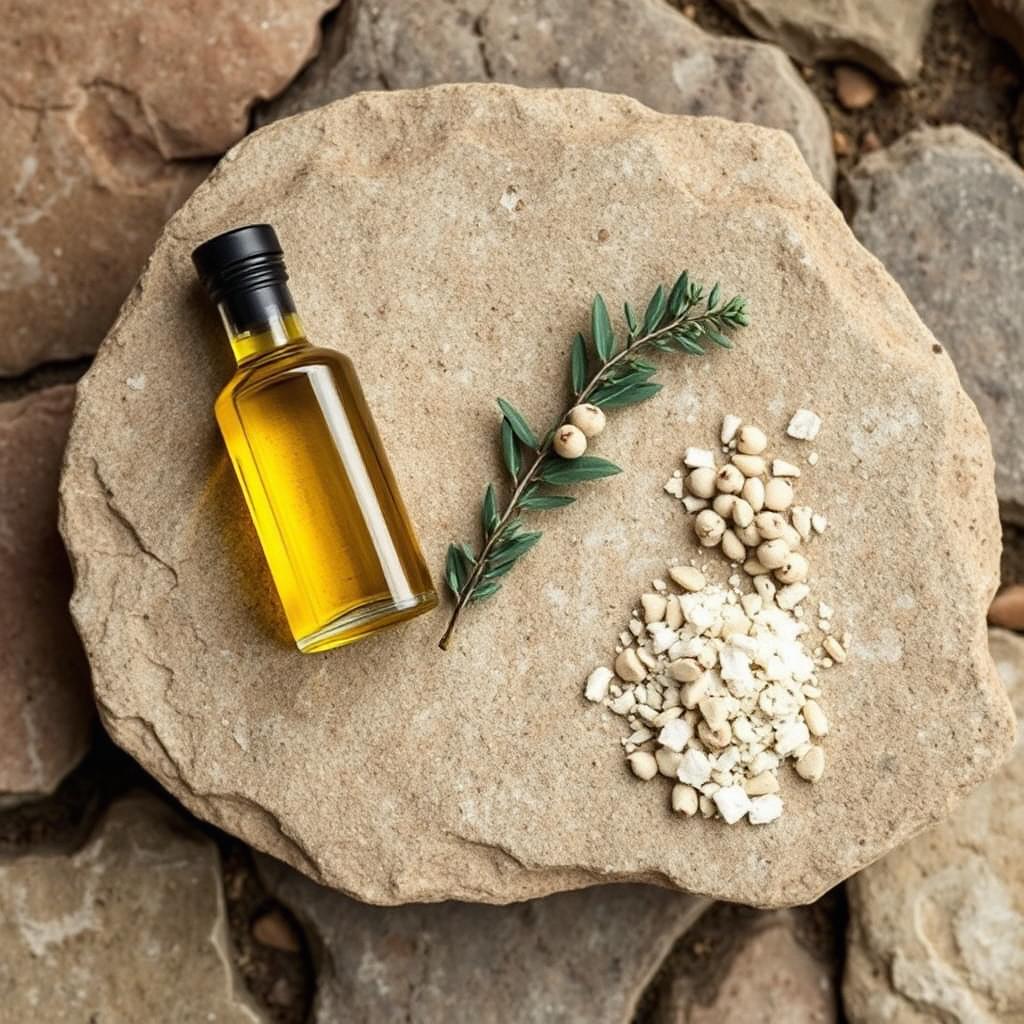
An authentic Aleppo bar answers none of these questions. The ingredient list is olive oil, laurel berry oil, water, and lye, where the lye is fully consumed during saponification and is not present in the finished bar. There is no foaming agent because the natural fatty acids in olive oil produce a low, creamy lather on their own. There is no preservative because the bar is naturally antimicrobial at its slightly alkaline pH of 8 to 10. There is no chelating agent because there is no synthetic surfactant to worry about hard water with. There is no fragrance because the laurel oil already smells faintly of forest and clean linen.
The reason this matters is not aesthetic. A short ingredient list is not minimalism for its own sake. It is, technically, what a fully cured saponified bar is supposed to look like. The chemistry of soap-making — fat plus alkali, cooked together until the saponification reaction completes — does not produce anything that needs to be stabilised. The bar is shelf-stable for years on its own. (We've written separately about whether the lye involved is actually natural, since that's the one ingredient the word "soap" tends to mystify.) Everything you see on a longer list is an addition, not a requirement.
Three ingredients is also, accidentally, the safest possible position from a sensitive-skin perspective. Almost every case of contact dermatitis traceable to a bar of soap turns out to be a reaction to one of the synthetic additives — most commonly a fragrance compound, a preservative, or a colourant. A bar with none of those substances has, by definition, almost nothing for the skin to react to. This is why traditional Aleppo soap has spent two thousand years quietly being the bar recommended for eczema, rosacea, and reactive skin — not because of a clever active ingredient, but because of everything it does not contain.
There is a phrase that the old soap quarter of Aleppo uses, more or less untranslatably, to describe what they make: the bar that is finished. It means a recipe that has reached the point where adding anything subtracts. Olive oil, laurel oil, lye, time. Anything more is somebody trying to sell you a problem the bar did not have.
— Filed from the workshop